Ketchup Started As Fish Sauce

Yes. Ketchup started as fish sauce. Not a tomato sauce with a little fish in it. A fermented fish brine from southern China, traded across Southeast Asia, carried home by British sailors, rebuilt in English kitchens with mushrooms and walnuts, and only turned red with tomato about 200 years ago. The bottle on your table is the last stop on a journey that started more than a thousand years before Heinz.
The bottle on your table is the last stop on a journey that started more than a thousand years before Heinz.
It started as fish sauce
The sauce began in Fujian province, on the coast of southern China. In Hokkien, the language spoken there, it was called kê-tsiap or kôe-chiap: the brine of pickled fish or shellfish. Fish and spices, salted and left to ferment until the liquid turned dark, salty, and intensely savory. Fermentation was the point. It preserved the fish and it built flavor that nothing else in the kitchen could match.
The first written recipe for it shows up in China in the year 544. Fermented fish pastes go back further than that, to around 300 BC on the Chinese coast, where preserving protein was a matter of survival. The idea was older than the name. Salt fish, let time do the work, and you get a sauce that keeps for months and makes plain food taste like something.
Rome had the same idea, centuries earlier, with garum: salted fish left to ferment into a dark, savory liquid that went into nearly everything. Different continent, same discovery. Fish plus salt plus time equals umami, long before anyone had a word for it.
Fish plus salt plus time equals umami, long before anyone had a word for it.
How a fish sauce crossed the world

Hokkien traders carried kê-tsiap through Southeast Asia, along the same sea routes that moved spices, tea, and porcelain. In the Malay world it became kecap, or kicap. The word is still there today. In Indonesia, kecap manis is a thick, sweet soy sauce, a descendant of the same family.
British and Dutch sailors met it in the ports of Malaysia and Singapore in the 1600s. It traveled well, it kept without spoiling, and it was salty and savory in a way European sauces were not. They brought it home.
The word entered English in 1682, listed among foreign luxuries in a pamphlet on coffee, tea, and chocolate. A slang dictionary from 1690 called it "Catchup, a high East-India sauce." In 1703, a trade manual singled out ketchup as a promising British import, and said the best came from Tonqueen, in what is now Vietnam. By then it was already a thing English merchants wanted to sell.
The exact path of the word is argued over. Linguists favor the Hokkien fish-brine origin, because the dates line up. There is a rival theory that it comes from a Cantonese phrase for tomato juice, but tomatoes reached Asia after the word ketchup was already circulating in English trade papers, so the timeline does not work. The fish came first. The tomato came later.
The English went wild with it
The British could not get the original sauce reliably, so they made their own. Ketchup stopped being one sauce and became a word for any thin, salty, spiced sauce you kept in a bottle.
Mushroom was the usual base. A housekeeping manual from 1733 lists "Kitchup, or Mushroom Juice." The first English recipe in print appeared in The Compleat Housewife, in 1727: anchovies, shallots, vinegar, ginger, and nutmeg, shaken once or twice a day for a week before using. A recipe from 1742 is even more direct: a gallon of stale beer, a pound of anchovies, mace, cloves, pepper, ginger, shallots, and a quart of mushrooms, boiled down by half and strained through flannel.
Walnut ketchup was the other favorite. Jane Austen's household made it, pounding green walnuts with salt, then boiling the mash with vinegar, cloves, mace, ginger, nutmeg, pepper, horseradish, and shallots. There were also oyster ketchup, lemon ketchup, elderberry ketchup, and beer ketchup. If it was thin, dark, salty, and spiced, somebody called it ketchup.
Mushroom ketchup never went away. You can still buy it bottled in Britain today.
Then the tomato showed up
Tomatoes were a New World fruit, grown in Europe since the 1500s but long avoided as food. People thought they were poisonous. In America, British colonists were suspicious of them too, and they were not widely eaten.
The first tomato ketchup recipe anyone can point to was published in 1812, by James Mease, a physician in Philadelphia. He called tomatoes "love apples," and his recipe used tomato pulp, spices, and brandy. No vinegar, no sugar. It was not the ketchup you know. It was the first time anyone had tried to build the sauce on a tomato instead of a fish or a mushroom.
Tomato ketchup had a problem the old sauces did not. It did not keep as well. The thin brown sauces were salty and fermented, so they lasted. A tomato sauce spoiled faster, which is why vinegar and sugar later became standard. They were not just flavor. They were preservation.
Heinz made it the red bottle
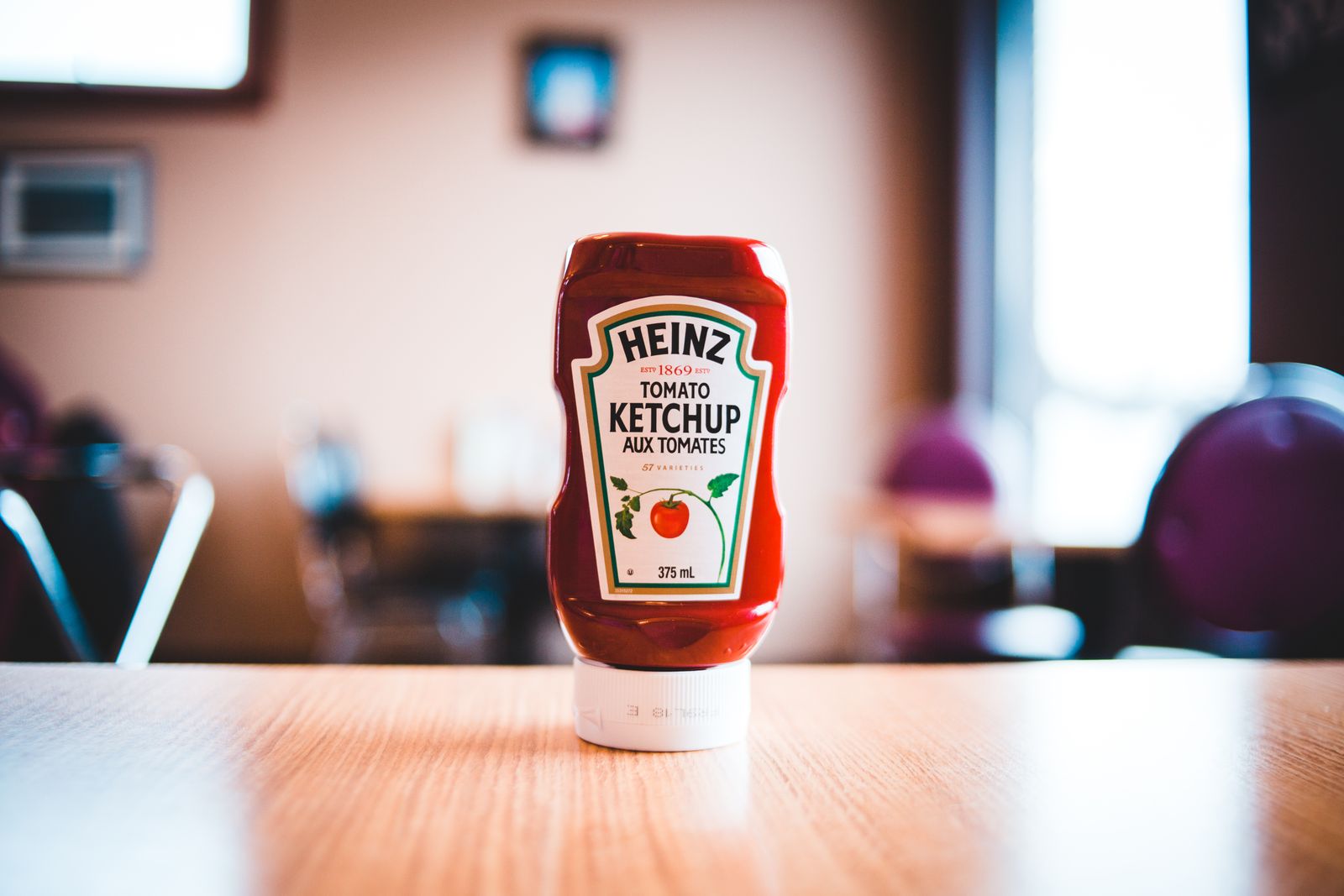
Commercial ketchups started appearing in the 1820s. A farmer named Jonas Yerkes was the first to sell bottled ketchup across the country, by 1837.
The early bottled stuff had a bad reputation. It was thin, watery, and preserved with sodium benzoate, a chemical preservative that became the center of a food safety fight in the early 1900s. Heinz built its name on the other side of that fight: ripe tomatoes, vinegar, and sugar, no benzoate, sold in clear glass bottles so you could see exactly what you were buying. Heinz gave factory tours to prove the point. It launched its tomato ketchup in 1876, and by 1905 it had sold millions of bottles.
Heinz also changed the spelling. Rivals sold "catsup." Heinz sold "ketchup," and the spelling stuck. The word that started as a Hokkien fish brine ended up on a red bottle in an American diner.
Why tomato worked
Tomato worked because it carried the same flavor signal as the fish. Tomatoes are rich in glutamic acid, the compound behind umami, the same savory depth that made the fermented fish sauce taste the way it did. The tomato replaced the fish because it spoke the same language to your tongue.
The original never died. It still goes by other names: Vietnamese nuoc mam, Thai nam pla, Filipino patis. Same idea, salt and fermented fish, still in kitchens across Southeast Asia. If you have ever cooked with fish sauce, you have used the sauce ketchup came from.
Worcestershire sauce is a cousin from the same family. Two chemists in Worcester, Lea and Perrins, bottled it in 1837, trying to copy a sauce a lord had brought back from India. Anchovies and all. It is still on the shelf, and it is still built on fermented fish.
Here is the part that matters if you cook. Fish sauce belongs in a kitchen that has nothing to do with Asian food. A dash in a tomato sauce, a stew, or a dressing does what ketchup does: salt, acid, and deep savory flavor. The bottle on the table is the sweet, tame version of a much older idea. The original is still in the pantry, and it is stronger.
The short version
Ketchup was a fermented fish brine from southern China, called kê-tsiap. Traders carried it to Malaysia, where it became kecap. British sailors brought it home, and English cooks rebuilt it from mushrooms, walnuts, and anchovies. Tomato arrived in 1812. Heinz bottled the red version in 1876. The fish is gone from the bottle, but the idea is still there: salt, fermentation, and umami. And the original is still alive, as nuoc mam and nam pla, in any kitchen that keeps a bottle of fish sauce.
Questions and answers
Was ketchup originally fish sauce? Yes. It began as kê-tsiap, the brine of pickled fish or shellfish from Fujian in southern China, salted and fermented until dark, salty, and intensely savory. Tomato did not enter the picture for about 200 years.
Where does the word ketchup come from? From the Hokkien fish-brine name kê-tsiap, carried through the Malay world as kecap, then into English in the 1600s. The exact path is argued over, but linguists favor the fish-brine origin because the dates line up.
What was in early ketchup before tomato? Mushroom was the usual base, plus walnut, anchovy, oyster, lemon, elderberry, and beer versions. If it was thin, dark, salty, and spiced, somebody called it ketchup.
When did tomato ketchup first appear? The first tomato ketchup recipe anyone can point to was published in 1812 by James Mease, a physician in Philadelphia. His version used tomato pulp, spices, and brandy, with no vinegar or sugar.
Who made modern ketchup famous? Heinz. It launched its tomato ketchup in 1876 and built its name on ripe tomatoes, vinegar, and sugar with no sodium benzoate, sold in clear glass bottles. Heinz also fixed the spelling as ketchup over catsup.
Is mushroom ketchup still made? Yes. Mushroom ketchup never went away, and you can still buy it bottled in Britain today.
What is the connection between ketchup and Worcestershire sauce? They are cousins from the same family. Lea and Perrins bottled Worcestershire in 1837, trying to copy a sauce brought back from India, and it is still built on fermented fish, anchovies included.
What is the original fish sauce called today? Vietnamese nuoc mam, Thai nam pla, Filipino patis. Same idea, salt and fermented fish, still in kitchens across Southeast Asia.
See all the tools I use on my Chef Recs page.
As an Amazon Associate I earn from qualifying purchases. Some links are affiliate links, and I may earn a commission if you buy through them, at no extra cost to you.
Andres Dangond is an executive chef and culinary consultant whose twenty years cover every corner of the industry: trained at Alinea and L2O in Chicago, chef owner of Alvecino in Bogotá, executive chef and partner at The Cut in Orange County, expedition cooking in the Alaskan wilds, and nearly a decade as Executive Chef and Director of Culinary Development at Lynx Grills under Middleby, alongside serving as the U.S. Brand Ambassador for Josper. He has spent twenty years in professional kitchens, from Alinea in Chicago to a decade running culinary development at Lynx Grills, cooking with the sauces that came out of that trade.


Comments