Convection, French Tops, and Real Range Control: Three Systems in One Box

Direct answer: A range is not one appliance. It is three different control systems sharing one box: a convection oven that controls heat with moving air, a French top that controls heat with position on a graduated iron plate, and open burners that control heat instantly, one pot at a time. Most owners only ever learn the burners. Real range control is choosing which system a dish belongs on, and moving food between them as it cooks, the same zone thinking as running a flat top.
System one: the convection oven, control by air
A convection oven adds a fan to the box. The fan moves hot air across the food, so heat arrives faster and more evenly than in a still oven. That is the whole mechanism, and everything useful about convection follows from it.
Moving air is why convection is the multi-rack system. In a still oven, the pan on the top rack and the pan on the bottom rack live in different climates. Circulating air narrows that gap, which is why Viking's use and care manuals position convection for multi-rack baking and heavier foods, and give rack pairings for it: positions 2 and 4, or 3 and 5, for two racks, staggered so no pan sits directly above another, with 1 to 2 inches of air space around each pan.
The conversion rule, straight from those same Viking manuals: to convert a conventional recipe to convection, reduce the temperature by 25 °F and expect the cooking time to drop by roughly 10 to 15 percent. Treat both numbers as a starting point, not a promise. The manuals are blunt that some recipes need adjustment and testing, and that convection items overbake easily, so pull food just before it looks done and let carryover finish it.
When does moving air hurt? When a food needs to set a skin or a structure before it gets blasted. The Viking manuals recommend conventional bake for custards and similar delicate baked goods, and that matches line experience: souffles, delicate cakes, and anything that rises on a fragile foam wants still air while it sets. Convection is a tool for browning, roasting, and volume. It is not a default.
System two: the French top, control by position
The French top, the plaque on a La Cornue, is a solid cast iron plate over a central burner. The center runs hottest and the surface cools toward the edges. La Cornue's own cooking manual calls the plaque the heart and soul of the range, and describes the working method in one line: the rings in the plaque diffuse the intensity of the heat, creating variable temperature zones, so instead of turning down the heat, you move the pans around the plaque to find the right temperature.
That is a different philosophy of control. A burner asks how much flame. A French top asks where the pot sits.
The working habits, from the La Cornue manual and from years cooking on plates like it:
Heat the plaque on high for 10 minutes before use. Cast iron needs the soak; a plate that reads hot in the center and cold at the rim is not ready.
The plaque holds 5 to 6 medium saucepans at once, and pans can overlap the stainless surround and keep cooking.
Melt chocolate and butter, and hold sauces, in a heavy pan set slightly offset toward the back, off the center heat.
Sear on the high heat burners, add wine and stock, then move the pan to the plaque to finish gently without evaporating the liquid you just built.
Hold finished food by pushing pans away from the center; bring them back toward the center to bring the temperature back up for service.
Rotate pans occasionally so the side closest to the center does not take a hot spot.
For wok cooking, the center rings come out and the wok sits in the opening, directly over the burner.
Notice what is missing: knob changes. Once the plate is soaked, the cook's hands move pans, not dials. It is the flat top lesson in a different material: the spatula, or here the slide, is the thermostat.
System three: open burners, control by the second
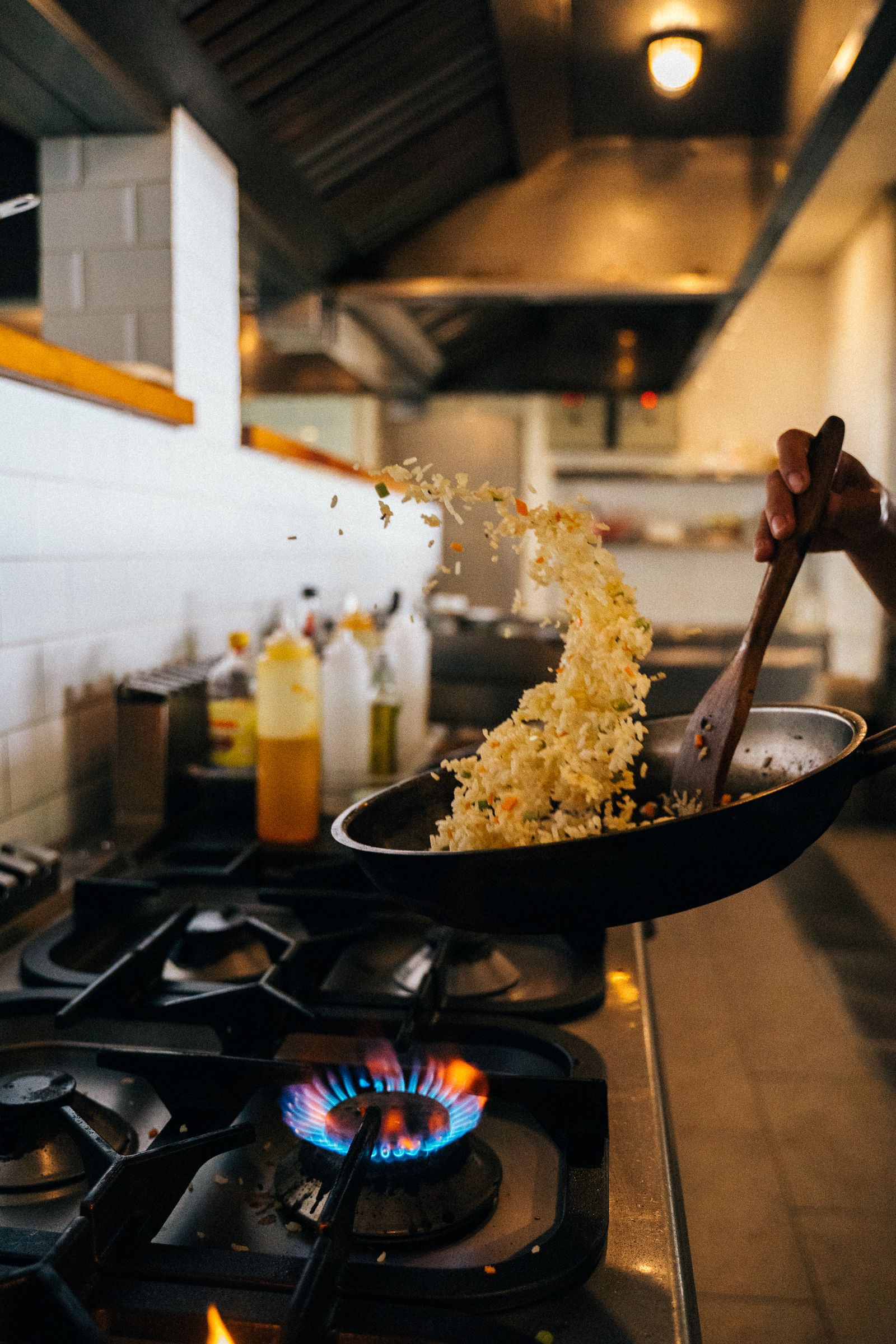
Open burners are the system everyone knows, and they earn it. Flame is instant, visible, and per pot. You see the heat, you change it, the pan answers in seconds. Nothing else on the range gives feedback that fast, which is why burners are where sauces get finished to the spoon, where a pan sauce gets its last reduction, and where anything that can go from right to ruined in thirty seconds belongs.
Their limit is the opposite of the French top's strength. A burner heats the pot sitting on it and nothing else. There is no holding geography, no gentle gradient to park things on. Food on a burner is cooking at that setting until you intervene. That is why a service run only on burners turns into a juggling act by the fourth pan.
One dinner, three systems

This is how the three systems divide a single meal in a working kitchen:
1. The roast goes in the convection oven, where moving air browns it evenly and the 25 degree conversion keeps the recipe honest. 2. The braise starts on a burner, gets its sear and its deglaze there, then slides onto the French top to finish low and slow at the plate's edge. 3. The sauce reduces on a burner at the end, under eyes, because that is the one item that cannot be parked. 4. Vegetables hold on the outer plaque, warm and not cooking, until the roast rests and the plates move.
No single system cooks that dinner well. The range was never one tool. It is a small line, and the cook is the one moving food along it.
The mistakes I see at demos
Running convection as a default. Owners turn the fan on for everything because the range came with it, then wonder why delicate bakes dry out and set badly. Choose the mode per dish.
Skipping the conversion. A conventional recipe run at full temperature in convection comes out dark and dry, and the oven gets blamed. Reduce 25 °F, start checking early.
Fighting the French top with the knob. Turning the burner under a cast iron plate up and down all service gives you a plate that is never stable anywhere. Soak it, then cook by position.
Crowding pans onto one burner in rotation. If three pans need holding, they belong on the plaque's edge or in a low oven, not in a queue for the one burner you trust.
Questions I get about range control
What is the convection conversion, exactly? Per the Viking use and care manuals: reduce the temperature by 25 °F from the conventional recipe, and expect roughly 10 to 15 percent less cooking time. Then adjust one variable at a time on the next cook if the result is not right.
When should I not use convection? For custards and delicate baked goods that need to set in still air, per the same manuals, and in practice for souffles and fragile foams. Use conventional bake for those, ideally single rack.
Is a French top the same as a flat top griddle? No, and the difference matters. A griddle cooks food directly on the steel. A French top cooks food in pans sitting on the plate; the plate is a heat gradient for cookware, not a cooking surface for the food itself. The zone thinking transfers. The technique does not, one for one.
How long does a French top take to preheat? La Cornue's guidance is to heat the plaque on high for 10 minutes before use. Thick plates on other ranges can take longer to fully soak; the test is whether the gradient is stable, center to edge, not what the clock says.
---
A range rewards the cook who knows which of its three systems a dish belongs on. Learn the air, the plate, and the flame as separate tools, and the box they share stops being a compromise and becomes a line you can run. This is the equipment layer I teach in trainings and demonstrate at events: not which range to buy, but how the one you have actually cooks.
About the author
Andres Dangond is an executive chef and culinary consultant whose twenty years cover every corner of the industry: trained at Alinea and L2O in Chicago, chef owner of Alvecino in Bogotá, executive chef and partner at The Cut in Orange County, expedition cooking in the Alaskan wilds, and nearly a decade as Executive Chef and Director of Culinary Development at Lynx Grills under Middleby, alongside serving as the U.S. Brand Ambassador for Josper. He consults on menu and recipe development, trains chefs and owners on cooking equipment, and works as a demo and event chef for equipment brands nationwide.
Sources drawn on for this post: Viking use and care manuals (convection conversion rule of 25 °F and roughly 10 to 15 percent less time, multi-rack positions and spacing, conventional bake recommended for custards and delicate baked goods), checked Oct 23, 2026; La Cornue Château Series cooking tips manual (the plaque: variable temperature zones from the rings, heat on high 10 minutes before use, 5 to 6 saucepans, offset melting and holding, sear on burners and finish on the plaque, center rings removable for wok cooking), checked Oct 23, 2026; the author's firsthand range and French top experience across his Middleby years and restaurant career for all technique guidance.


Comments